





Interesting to note; our cell phones today have more computing power than NASA had for the first landing on the moon. The insides of these mobile devices that we can’t live without are not like personal computers or even laptops with a traditional CPU (central processing unit) and a dozen other support chips. The brain, heart, and soul of today’s cell phone is a single chip called an SoC or System on Chip, which is a literal definition.
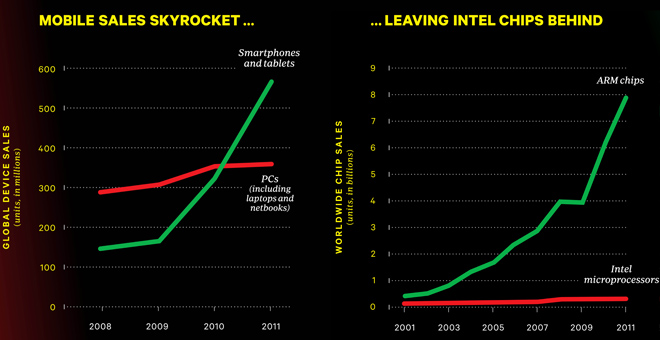
Sources: Device Sales: Gartner, IDC; Chip Sales: ARM, Wired Research
The demands on cell phones are daunting. What were once simple tasks; talk, text, email, now include photos, music, streaming video, GPS, and artificial intelligence (Apple Siri / Android Robin), all now done simultaneously.
I worked my way through college as a field engineer for Data General mini computers. CPUs were dozens of chips on multiple printed circuit boards, memory was on multiple boards, I/O was a board or two. Repairing computers back then was a game of board swap based on which little red lights blinked or stopped blinking on the front panel. My first personal computer was a bit more compact. It had a mother board with multiple chips and slots to plug in other boards for video, disk, modem, and other interfaces to the outside world. Those boards are now chips on a single mother board which is what you will see inside your laptop.
Today, this entire system is on one chip. Per Wikipedia:
A system on a chip or system on chip (SoC or SOC) is an integrated circuit (IC) that integrates all components of a computer or other electronic system into a single chip. It may contain digital, analog, mixed-signal, and often radio-frequency functions—all on a single chip substrate.
Let’s look at the first iPhone tear down which can be found HERE. The original iPhone was released June 29, 2007 and featured:
- 480×320 display
- 16GB storage
- 620MHZ single core CPU
- 103MHZ GPU
- 128MB DRAM
- 2M pixel camera
Compare this to the current iPhone4s tear down which can be found HERE. The iPhone 4s was released October 4, 2011 and features:
- 960×640 display
- 64GB storage
- 1GHZ dual core CPU
- 200MHZ GPU
- 512MB DRAM
- 8M pixel camera
There is a nice series of Smart Mobile articles on SemiWiki which cover the current SoCs driving our phones and tablets:
It will be interesting to see what the iPhone5 brings us but you can bet it will be an even higher level of SoC integration; a quad core processor, a 2048×1536 display, and a 12M pixel camera, yet in a slimmer package.
The technological benefits of SOCs are self-evident: everything required to run a mobile device is on a single chip that can be manufactured at high volumes for a few dollars each. The industry implications of SoCs are also self-evident: as more functions are consolidated into one SoC semiconductor companies will also be consolidated.
The other trend is the transformation from traditional semiconductor companies (IDMs and fabless) to semiconductor intellectual property companies such as ARM, CEVA, and Tensilica. This is partly due to the lack of venture funding made available to semiconductor start-ups (it costs $100M+ to get a leading edge SoC into production), but also due to the mobile market which demands SoCs be highly integrated and power efficient with a very short product life. As a result, hundreds of semiconductor IP companies are emerging and hoping to ride the SoC tidal wave leaving traditional semiconductor companies in the wake.
A Brief History of Semiconductors
A Brief History of ASICs
A Brief History of Programmable Devices
A Brief History of the Fabless Semiconductor Industry
A Brief History of TSMC
A Brief History of EDA
A Brief History of Semiconductor IP
A Brief History of SoCs



Real men have fabs!